


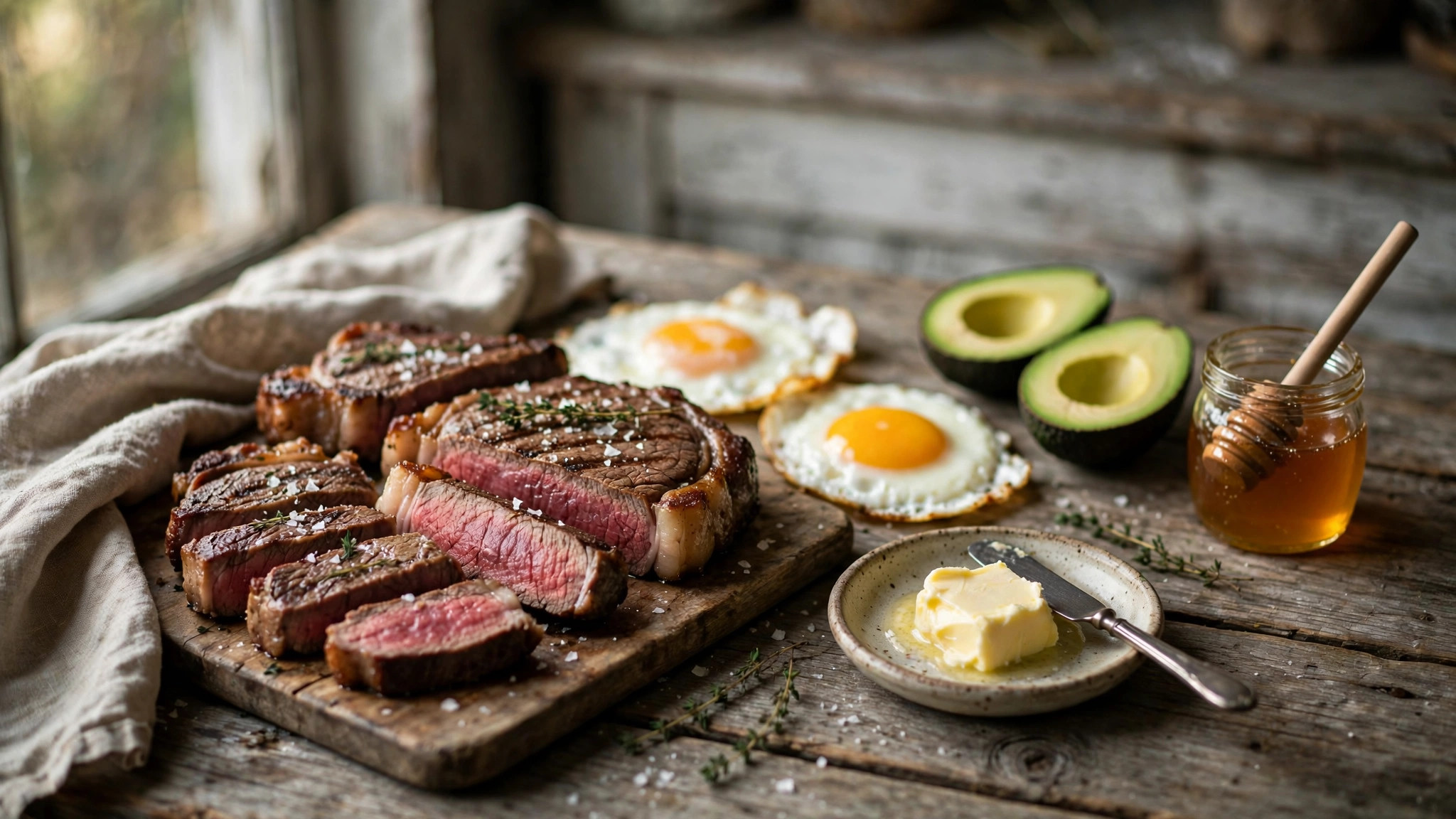
If you have been wondering what the primal diet actually is, here is the whole thing in one sentence: eat the way humans ate before factories started making our food.
That is it. That is the diet.
These days people call it animal-based. You build your meals around animal foods (meat, eggs, dairy if you tolerate it) and round them out with the plant foods humans have always eaten (fruit, vegetables, honey). What is new is not the food. What is new is that we spent fifty years being told to fear it.
The short version: eat this, skip that
Let us keep this stupid simple.
Eat: beef, lamb, pork, chicken, fish, eggs. Organs if you are feeling brave (start with liver mixed into ground beef, you will not taste it). Butter, tallow, lard. Raw cheese and heavy cream if dairy agrees with you. Fruit. Vegetables. White rice and potatoes if you are active. Honey. Salt. Lots of salt.
Skip: seed oils (canola, soybean, corn, and their sneaky cousins). Ultra-processed anything. Sugary drinks. The snack aisle, blah blah, you know the stuff. Cannot pronounce it? That is your answer.
Why meat sits at the center
Here is the part the headlines skip: meat is the most nutrient-dense food you can put on a plate. A ribeye hands you complete protein, B12, zinc, and heme iron in the form your body actually absorbs. Good luck getting that from a fortified cereal.
Protein also keeps you full in a way carbs do not. Researchers reviewing the evidence found that protein increases satiety more than carbohydrate or fat, bumps up thermogenesis, and helps you hold onto muscle while you lean out (Paddon-Jones et al., 2008).
And about the red meat scaremongering: when an international panel graded the actual evidence behind the eat-less-red-meat guidelines, they called it low-certainty evidence and issued a weak recommendation (Johnston et al., 2019). Translation: the science is a lot less settled than the headlines pretend.
Fat is fuel, not the enemy
Somewhere along the way, fat became the villain. The problem was never fat. The problem was which fats.
A meta-analysis of 21 studies following nearly 350,000 people found no significant link between saturated fat intake and heart disease or stroke (Siri-Tarino et al., 2010). Read that again. The thing we have been told to fear for decades did not hold up.
What does cause problems is the other stuff: industrial seed oils that oxidize inside you and drive inflammation. So we cook with the fats humans have always cooked with. Tallow for searing, butter for everything else. If you want to try it, this is the grass-fed tallow I keep next to the stove.
What about cholesterol?
Straight answer: the cholesterol story is messier than either side admits. One big 2019 analysis did link higher dietary cholesterol and egg intake to more heart events (Zhong et al., 2019). It is observational, not a lab experiment, but I am not pretending it does not exist.
I eat eggs most days (my cast iron steak and eggs is basically a food group at this point) and I am not losing sleep over it. Food first, fear never.
Carbs: earn them
I am not anti-carb. I am anti-mindless-carb.
A good baseline is staying under about 150 grams a day, which is easy when your meals are meat, veggies, and fruit. The standard American diet blows past 300 without trying (cereal, sandwich, pasta, repeat), and all that extra energy has one place to go: storage.
But if you are training, lifting, or sprinting? You earn your carbs. White rice, potatoes, fruit, honey. Clean sources, eaten on purpose, not inhaled from a bag.
The real enemy is ultra-processed food
If you only change one thing, make it this: quit ultra-processed food.
In a tightly controlled NIH trial, people in a metabolic ward ate about 500 extra calories a day on ultra-processed meals versus unprocessed ones, even with macros, sugar, sodium, and fiber matched. They gained on the junk and lost on the real food (Hall et al., 2019).
Same calories on paper. Completely different result in the body. That is the whole game.
How to start this week
Three steps. That is all.
1. Build every meal around a protein. Meat, eggs, fish. Eat plenty, especially if you are training.
2. Swap your cooking fat. Out: the plastic bottle of canola. In: tallow, butter, or lard. A 12-inch cast iron skillet (this is the one I use) plus hot tallow will handle 90 percent of your cooking.
3. Salt your food like you mean it. Real salt, not the blue canister dust. When you drop processed food, your sodium drops with it, and you will feel it. This is the salt in our kitchen.
Do that for two weeks and pay attention. Most people notice the afternoon crash disappears first.
That is the basics. No dogma, no 47 rules. Eat animals, eat plants, skip the factory stuff.
P.S. Want the starter version of all this with the gear list and my go-to meals? Grab the free Primal Arsenal guide. And if you want to see what this looks like on a plate, start with my reverse-seared smoked skirt steak. Try it yourself, you will not be sorry.